
The Questions Every Smart Used Car Buyer in Ocala Should Ask Before Spending $20,000
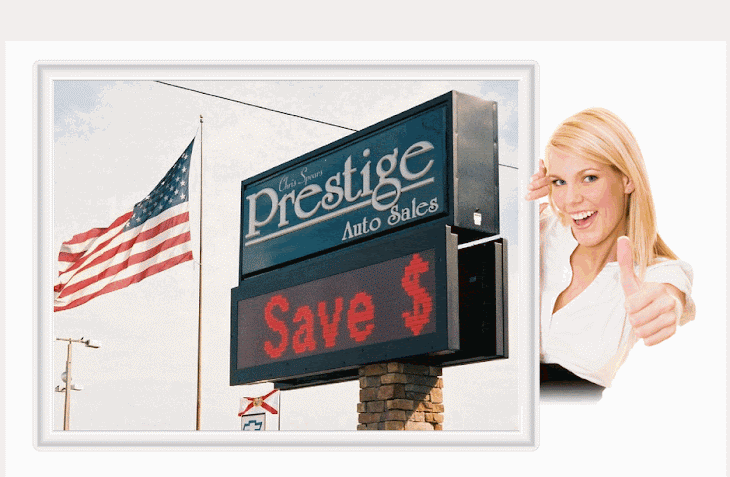
Spending $20,000 on a used car is a serious financial commitment — and in Marion County, where commutes stretch from Silver Springs to Dunnellon and down to The Villages, the wrong vehicle at the wrong price can follow you for years. Yet most buyers spend more time researching a restaurant than they do vetting a $20,000 purchase. We sat down with Chris Spears, owner of Prestige Auto Sales, to get his perspective on the questions that separate informed buyers from ones who walk away with regret. Here's what he had to say.
"Is this a cash sale or a finance sale?"
It sounds simple, but Chris Spears says this is one of the first things every buyer should get clear on before they start shopping. The reason is that the answer changes almost everything — how you negotiate, what leverage you have, and what total cost actually looks like. Cash buyers are working with a fixed number and should be focused entirely on what that number gets them. Finance buyers have an entirely different set of variables in play, starting with their credit profile and ending with the total amount repaid over the life of the loan. Knowing which category you're in before you walk onto a lot means you're negotiating on your terms, not someone else's.
"What does my credit actually qualify me for?"
For buyers who are financing, this question matters more than almost any other. Most people walk onto a lot without knowing their real number, which puts them at an immediate disadvantage. A dealer who controls both the car selection and the financing controls the entire conversation. Before you visit any dealership, pull your credit report, know your score, and have a realistic sense of the interest rate range you qualify for. That one step shifts the leverage back in your favor before a single word is spoken.
"Do I know my family's budget — and am I committed to it?"
This is one of the points Chris Spears feels most strongly about. "Know your family's budget before you leave the house, and honor that investment," he says. His reasoning is straightforward: if you've decided that you don't want a vehicle consuming more than 20 or 25 percent of your family's monthly budget, that number needs to be locked in before you're standing in a showroom looking at something you love. Without that commitment made in advance, it's easy to get excited in the moment and stretch to 40 percent of your budget — only to feel that pressure every month for the next several years.
"What's the total cost — not just the monthly payment?"
A $399 per month payment sounds completely manageable until you realize it's stretched over 84 months at a high interest rate, and you've paid close to $33,000 for a $20,000 car. Always ask for the full picture: the amount financed, the interest rate, the loan term, and the total repayment amount. If a salesperson seems reluctant to walk you through those numbers clearly, that reluctance is telling you something.
"Is $20,000 actually $20,000 here?"
This is a question most buyers never think to ask, and Chris Spears says it's one of the most important ones. Not every dealership defines $20,000 the same way. Some charge a modest administrative fee that has minimal impact on your buying power. Others tack on $3,000 or $4,000 in fees that, as Spears puts it, "have to come out of your hand" — meaning less money available for the actual vehicle. Understanding what a dealership's fees look like before you fall in love with a car protects you from a budget surprise that arrives at exactly the wrong moment.
"Has this vehicle been independently inspected?"
A used car that hasn't had eyes on it from a mechanic you trust is a gamble, full stop. Any reputable seller will welcome an independent inspection — it protects both parties. If you're met with hesitation or excuses, treat that as a serious red flag. In a market like Ocala, where many buyers are putting real miles on their vehicles every week, mechanical reliability isn't a nice-to-have. It's the whole point of the purchase.
"What does the service history actually look like?"
An independent inspection tells you the condition of the vehicle today. The service history tells you how it got there — and that distinction can be worth real money. Chris Spears puts it plainly: if you're comparing two vehicles that are similar in price and condition, but one has a fresh set of tires, a completed brake job, and updated maintenance, while the other doesn't, those aren't really the same deal. The unserviced vehicle could easily cost that family an extra $2,000 in the first year alone just catching up on what the previous owner or dealer didn't do. A lower sticker price on a neglected vehicle isn't a bargain — it's a deferred expense. Always ask for documentation of recent service, and factor what's missing into your offer.
"What is this vehicle actually worth in today's market?"
Used car prices have been volatile in recent years, and sticker prices don't always reflect reality. The good news, according to Chris Spears, is that buyers have more tools than ever to protect themselves. Kelley Blue Book has long been the standard reference, but Spears notes that sites like CarGurus, AutoTrader, and Carfax.com now offer their own value estimates built directly into their platforms. "These tools help keep customers out of trouble and from overspending," he says. Cross-referencing two or three of these sources before you negotiate gives you a grounded, defensible position — and makes it much harder for an inflated sticker price to go unchallenged.
The smartest used car buyers in Ocala aren't necessarily the ones who know the most about cars. They're the ones who arrive with the right questions already answered — budget committed, market value researched, and financing understood — before anyone starts running numbers.


No comments:
Post a Comment